
When we think of snakes, we often imagine them slithering on the ground or hiding in burrows. But did you know that some species actually live in trees? Meet the Chrysopelea ornata, a remarkable snake known for its gliding ability and striking appearance. Let’s take a closer look at this fascinating reptile!
🌳 Snakes on Trees: What You Need to Know!
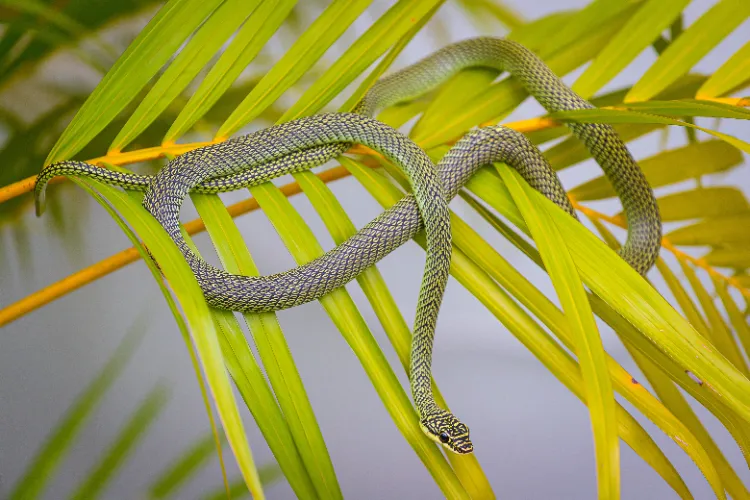
The Chrysopelea ornata, commonly called the golden flying snake, is a tree-dwelling species that measures between 1 and 1.2 meters in length. Males are usually slightly smaller than females. This snake is native to Southeast Asia, thriving in tropical forests where temperatures range between 28 to 32°C.
🔹 It is often found in gardens and plantations, making it more common than you might think!
🔹 Nicknamed the “flying snake”, it has the unique ability to glide between tree branches, making it one of nature’s most fascinating reptiles.
🎨 A Stunning Appearance
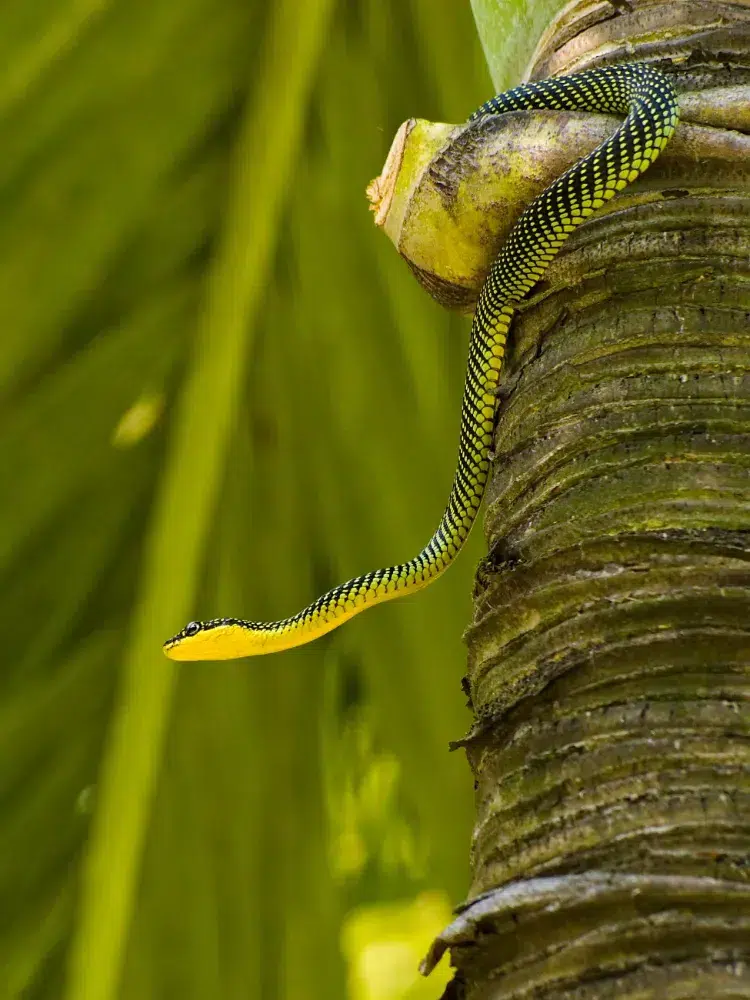
The Chrysopelea ornata boasts vibrant green scales with black tips, giving it a striking look. Its belly is lighter, often appearing yellowish.
✔ Its angular-shaped scales help it grip tree trunks and branches, allowing it to move effortlessly in its arboreal habitat.
✔ It can also climb rocks and even buildings, making it an expert climber.
For a long time, this was believed to be the only flying snake, but recently, another species—Dendrelaphis—was discovered in Australia with a similar ability.
🛫 How Does the Flying Snake Glide?
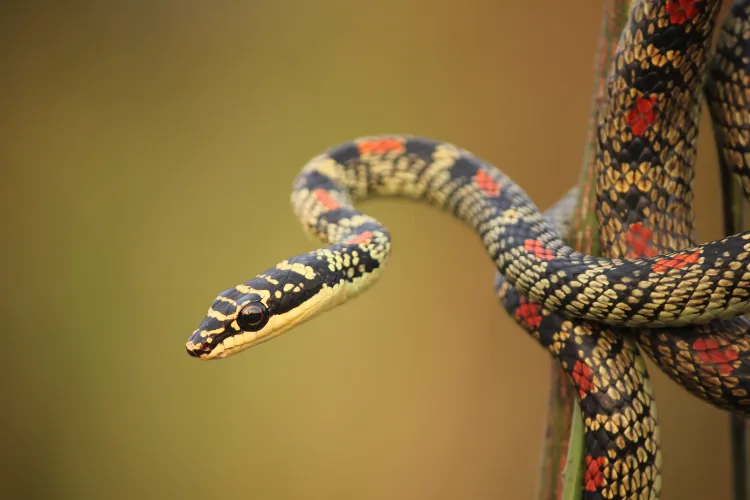
Let’s clarify one thing: the Chrysopelea ornata does not truly fly. Instead, it performs controlled gliding jumps to move from one branch to another or descend to the ground.
✨ How Does It Work?
✔ Expanding its ribs – The snake widens its body by spreading its ribs, increasing the surface area of its belly.
✔ Forming a concave shape – It pulls in its belly, creating a curved shape that helps generate aerodynamic lift.
✔ Undulating movements – While gliding, the snake moves in an S-shape, combining vertical and horizontal waves to stabilize its flight.
💡 Fun Fact: Depending on the height from which it jumps, the flying snake can glide for several dozen meters! Without its characteristic undulating motion, it would fall uncontrollably.
📌 Bonus: Chrysopelea Identity Card
⚠ Is the Flying Snake Dangerous?
Good news! Although the Chrysopelea ornata is venomous, its bite is not dangerous to humans unless you are allergic.
✔ It belongs to the opisthoglyphous group, meaning it has fangs located at the back of its jaw.
✔ Its venom paralyzes its prey almost instantly, making it an efficient predator.
🍽 What Does It Eat?
The golden flying snake primarily hunts small prey, including:
🐸 Frogs
🦎 Geckos (its favorite meal!)
🐦 Small birds
🐭 Rodents and other small mammals
🥚 Reproduction & Lifecycle
✔ Oviparous species – meaning it lays eggs.
✔ Mating season – May to June.
✔ Eggs laid in tree cavities – Typically 5 to 12 eggs at a time.
✔ Hatchlings measure 11-15 cm long.
🚨 The Threats Facing the Flying Snake
Unfortunately, despite its impressive skills, the Chrysopelea ornata faces several threats:
🔹 Urbanization – As forests are destroyed, the snake’s natural habitat is rapidly shrinking.
🔹 Illegal pet trade – Some people capture these snakes to sell as exotic pets.
🔹 Hunted for food – In some regions, this snake is sold as a delicacy.
Although difficult to catch, conservation efforts are needed to protect this incredible species from extinction.
🏆 Final Thoughts: Nature’s Acrobat
The golden flying snake is a true marvel of nature. With its vibrant colors, unique gliding ability, and incredible adaptability, it remains one of the most fascinating reptiles in the animal kingdom.
🐍 Have you ever seen a flying snake in action? Let us know in the comments!


