Did you know there are aerial snakes? While most snakes are terrestrial or aquatic, there are species that thrive in the trees! Particularly abundant in Southeast Asia and the forests of India, these snakes glide from branch to branch. Let’s introduce you to this fascinating creature!
Snakes on Trees: What You Need to Know!
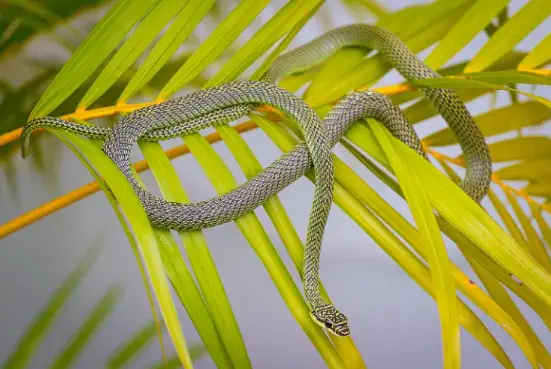
The Chrysopelea ornata is a remarkable tree snake, measuring between 1 and 1.20 meters long. Males are generally slightly smaller than females. Found primarily in the tropical forests of Southeast Asia, where temperatures hover around 28 to 32 degrees, this snake is often spotted in gardens and plantations. Nicknamed the “flying snake,” it moves gracefully between branches by gliding.

The Chrysopelea ornata features stunning green scales with black tips, earning it the nickname “golden flying snake.” Its lighter, yellow-tinged belly helps it camouflage among foliage. With angular shapes, it easily navigates trees, rocks, and buildings, making it quite elusive. For a long time, it was believed to be the only flying snake until the Dendrelaphis species was discovered in Australia.
How Does It Do It?
Let’s clarify: the Chrysopelea doesn’t actually fly. Instead, it performs gliding jumps from branch to branch or to the ground. This is achieved by spreading its ribs, increasing the surface area of its belly, and pulling in its body to form a concave shape. While gliding, it flattens part of its body, generating the aerodynamic forces necessary for a controlled descent. During its jumps, it undulates its body in a combination of vertical and horizontal movements to ensure a safe landing. Depending on the height from which it launches, it can glide for several dozen meters!
Bonus Snake on Trees: Chrysopelea Identity Card
Good news: while the Chrysopelea is venomous, its bite is generally not dangerous to humans unless one is allergic. This opistoglyph snake primarily feeds on small prey using its rear fangs. Its diet includes:
- Gecko-type lizards
- Birds
- Frogs
- Small mammals
Its venom can paralyze prey almost instantly. In terms of reproduction, the flying snake is oviparous, with mating occurring from May to June. During this time, the female lays five to twelve eggs in tree cavities. Young snakes measure between 11 and 15 centimeters at birth.
Unfortunately, the Chrysopelea is considered endangered due to habitat loss from urbanization and its capture for food and as pets. While these snakes are hard to catch, their future remains uncertain.
Stay informed about wildlife and consider ways to protect these unique species!