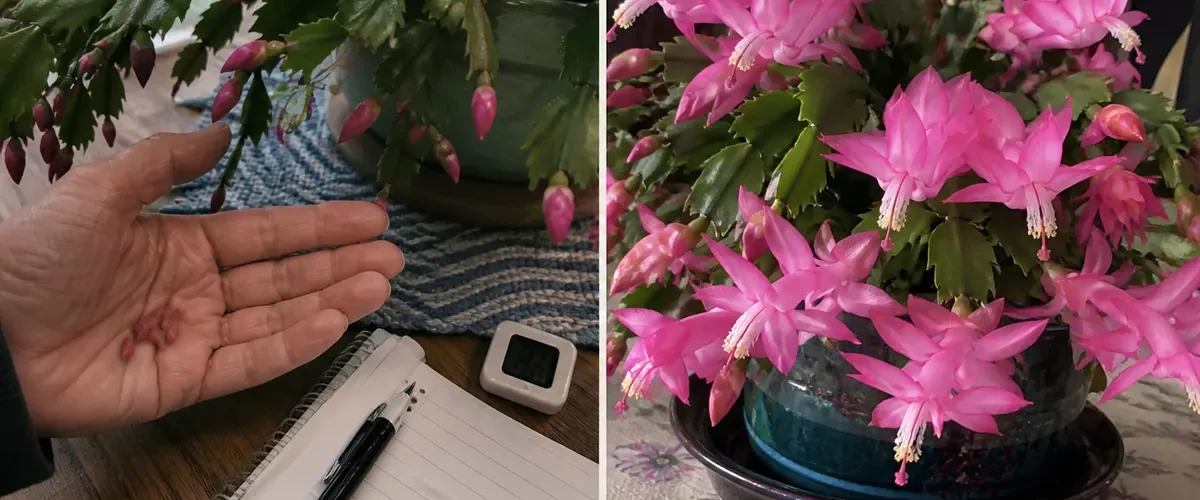
Finish with the full record. A retained-bud percentage can separate a true night-cycle outcome from tea poured after bloom induction.
Use the same viewing angle. The source Drop One Booster and Christmas Flowers Bloom Without Stopping links feeding brewed tea, cloves, and sugar to make Christmas cactus bloom two or three times a year to this mature Christmas cactus after bloom claim: one sweet phosphorus-rich drink covers every segment in nonstop buds.
Define the Supported Outcome: Keep the Nonstop-Bloom Hook and Protect the Bud Clock
Hold the comparison steady. Tea, cloves, and sugar do not provide a known complete nutrient balance, and sweet residue can feed microbes or pests. Christmas cactus flowering depends strongly on mature growth, long uninterrupted nights, suitable cool temperatures, careful watering, and stable placement. Once buds form, sudden heat, drought, saturation, or moving the plant can cause drop.
Treat this as evidence. Before changing the mature Christmas cactus after bloom, write this expected outcome: a mature holiday cactus holding many realistic buds through development and opening into an impressive seasonal ring of blooms. Accept the christmas cactus bud-retention clock only when the buds retained from first pinhead stage to open blooms and the wider mature Christmas cactus after bloom document improve together.
Explain the Working Mechanism: Why Darkness and Stable Roots Hold Developing Flowers
Keep the unit unchanged. For this mature Christmas cactus after bloom, the proposed mechanism is testable. Night length and temperature signal the plant to shift from vegetative growth to buds. Mature segments supply stored energy. Roots require moisture and air, while stable conditions protect developing buds. Sugar in soil cannot replace photosynthesis and can change microbial activity around roots.
Keep outside variables fixed. The controlled mature Christmas cactus after bloom comparison therefore follows stopping sweet tea, giving mature segments several weeks of long uninterrupted nights and species-safe cool temperatures, watering only when the mix begins to dry, draining completely, using complete labeled fertilizer during active growth rather than induction, and leaving a budding plant stable. Before crediting one treatment, hold the strongest mature Christmas cactus after bloom outside variable steady.
Read the Follow-Up Evidence: Follow Pinhead Buds Until the Final Petals Open
Separate timing from cause. Observation window: a long-night routine usually requires several consistent weeks before buds become visible. Pinhead buds then enlarge over more weeks. A second bloom is possible for some plants under favorable cycles, but nonstop blooms are not realistic. Track bud retention rather than crediting a drink applied after induction already occurred.
Start with the baseline. Evidence rule: Count mature segments and mark the first buds before any treatment. Document darkness, temperatures, water, movement, and retained buds weekly. The method works when a larger share of pinhead buds reach open blooms without sour mix or pest increase.
Run the Controlled Procedure: Move From Mature Growth to Buds Without Sweet Tea
- End the sweet booster. Flush only if residue is evident and the container drains well, then stop sugar tea.
- Start a true long-night block. Give uninterrupted darkness at consistent times for several weeks.
- Keep nights safely cool. Avoid heat vents, freezing glass, and dramatic temperature shocks.
Observed Outcome: Finish 4: Water from mix evidence
Check the stop rule now. Moisten thoroughly when needed and empty every decorative saucer.
Observed Outcome: Finish 5: Protect newly visible buds
Read the response carefully. Stop rotating and moving the plant while holding temperature and moisture steady.
Observed Outcome: Finish 6: Feed after active growth resumes
Repeat under equal conditions. Use complete labeled cactus feed modestly when new segments develop.
Capture the Starting Dataset: Read Night Length, Temperature, Segments, Moisture, and Movement
Record the weakest result too. Baseline inventory: confirm the cactus type and bloom history. Document hours of uninterrupted darkness, night temperature, window heat, container moisture, drainage, new segment maturity, recent movement, fertilizer, and bud drop. Inspect sour soil, fungus gnats, root damage, and residue from tea or sugar.
Remove Four Confounding Errors: Four Flower-Booster Claims That Cause Christmas Bud Drop
Mistake 1: Calling tea phosphorus fertilizer
Finish with the full record. Its nutrient amount is unknown and incomplete.
Mistake 2: Adding sugar for plant energy
Use the same viewing angle. Plants make sugars through photosynthesis. Roots do not require a sweet drink.
Mistake 3: Interrupting darkness with room lights
Hold the comparison steady. A short bright interval can weaken the flowering cue.
Mistake 4: Moving a plant full of buds
Treat this as evidence. Changed direction, heat, and moisture can increase bud drop.
Apply the Stop Conditions: Control Heat, Sugar, Cold, Fertilizer, Tools, and Pot Stability
Keep the unit unchanged. Stop conditions: keep hot liquids away from plants and people, clean sugary spills, and store fertilizer safely. Avoid cold exposure outside the plant’s range. Isolate pests, sanitize tools, and never mix plant products. Place heavy cascading pots on stable supports.
Keep outside variables fixed. Reject the booster claim when bud induction began before the tea or conditions changed at the same time.
Give Give Your Christmas Cactus Longer Nights and Watch It Fill With Buds One Final Evidence Test
Separate timing from cause. At the planned mature Christmas cactus after bloom interval, repeat the buds retained from first pinhead stage to open blooms baseline. Pair that buds retained from first pinhead stage to open blooms value with the full mature Christmas cactus after bloom document. When both support a mature holiday cactus holding many realistic buds through development and opening into an impressive seasonal ring of blooms, the christmas cactus bud-retention clock earns another controlled cycle.


